HR for Small Businesses: How to Build a Compliant Framework from the Ground Up
Introduction
For many small business owners, HR is something that grows reactively.
You hire your first employee, download a contract template, add a few policies, deal with issues as they arise, and gradually build processes over time. That is how many SMEs operate.
The problem is that reactive HR often creates inconsistency, confusion, and avoidable legal risk.
By the time businesses realise their HR foundations are weak, it is usually because they are already dealing with:
employee disputes
sickness absence issues
performance concerns
grievances
disciplinary problems
documentation gaps
compliance concerns
management inconsistency
rising costs
leadership distraction
At that point, fixing HR becomes urgent — and often more expensive.
The better approach is to build your HR framework intentionally from the beginning.
Done properly, a strong HR framework does far more than keep you compliant.
It helps you:
✓ hire better
✓ manage confidently
✓ improve retention
✓ reduce conflict
✓ strengthen culture
✓ protect the business
✓ support growth
For SMEs, HR should not feel corporate or complicated.
It should be practical, proportionate, and commercially useful.
This guide explains how to build an effective HR framework from the ground up.
What Is an HR Framework?
An HR framework is the structure that supports how you employ, manage, support, and develop your people.
Think of it as the operating system behind your workforce.
It includes:
contracts
policies
onboarding
manager guidance
employee relations processes
absence management
documentation
performance management
training
legal compliance systems
Without structure, HR becomes reactive.
Reactive HR creates risk.
Structured HR creates confidence.
The 7 Foundations Every SME Needs
1) Strong Employment Contracts
Everything starts here.
Contracts create clarity around:
✓ pay
✓ hours
✓ duties
✓ notice
✓ probation
✓ confidentiality
✓ flexibility
✓ policy obligations
Poor contracts create disputes.
Good contracts create certainty.
Given 2026–2027 reforms around day-one rights, SSP, family leave, and earlier dismissal protection, contracts should now be reviewed carefully.
Do not rely on outdated templates.
2) Core HR Policies
Policies translate legal obligations into practical workplace standards.
At minimum, SMEs should have:
✓ disciplinary
✓ grievance
✓ sickness absence
✓ equality / EDI
✓ dignity at work / anti-harassment
✓ family leave
✓ flexible working
✓ data protection / GDPR
✓ whistleblowing
✓ health & safety responsibilities
Policies reduce ambiguity.
Managers need clarity.
Employees need consistency.
3) Effective Onboarding
Many SMEs underestimate onboarding.
Strong onboarding should cover:
✓ role clarity
✓ expectations
✓ training
✓ policies
✓ systems access
✓ introductions
✓ early review meetings
✓ documentation completion
Employees who start well generally perform better and stay longer.
Poor onboarding creates avoidable friction.
4) Probation Management
Probation is becoming far more important.
With unfair dismissal protection reducing to 6 months from January 2027, probation can no longer be loosely managed.
Introduce:
✓ 30-day review
✓ 60-day review
✓ 90-day review
✓ documented feedback
✓ improvement support
✓ extension framework
Good probation management reduces hiring mistakes.
5) Manager Capability
Most HR risk does not come from policy gaps.
It comes from management decisions.
Managers need confidence in:
✓ difficult conversations
✓ performance management
✓ absence management
✓ investigations
✓ disciplinaries
✓ grievances
✓ documentation
✓ wellbeing conversations
Manager training is one of the highest ROI HR investments.
6) Documentation Systems
If it is not documented, it becomes difficult to evidence later.
Keep structured records for:
✓ absence
✓ probation
✓ performance conversations
✓ disciplinary matters
✓ grievances
✓ adjustments
✓ investigations
✓ training
✓ policy acknowledgement
Documentation protects decisions.
7) Regular HR Review
Employment law changes quickly.
Your HR framework should be reviewed regularly.
Check:
contracts
policies
processes
manager capability
employee experience
compliance risks
Reactive review is expensive.
Proactive review is protection.
The Biggest SME HR Mistakes
The most common problems are:
❌ copying templates from Google
❌ inconsistent contracts
❌ outdated policies
❌ no probation framework
❌ managers untrained
❌ poor documentation
❌ reactive employee relations management
❌ no HR audit process
These issues compound over time.
Practical SME HR Checklist
Ask:
✓ Do we have robust contracts?
✓ Are policies current?
✓ Is onboarding structured?
✓ Is probation managed actively?
✓ Are managers trained?
✓ Is documentation strong?
✓ Are we keeping pace with employment law change?
If several answers are “no”, there is an opportunity to strengthen your framework.
Key Takeaway
Good HR is not bureaucracy.
Good HR is business infrastructure.
It protects your people, supports your managers, reduces legal
exposure, and creates a stronger platform for growth.
For small businesses, a compliant HR framework is not a luxury.
It is one of the smartest operational investments you can make.
Related Articles
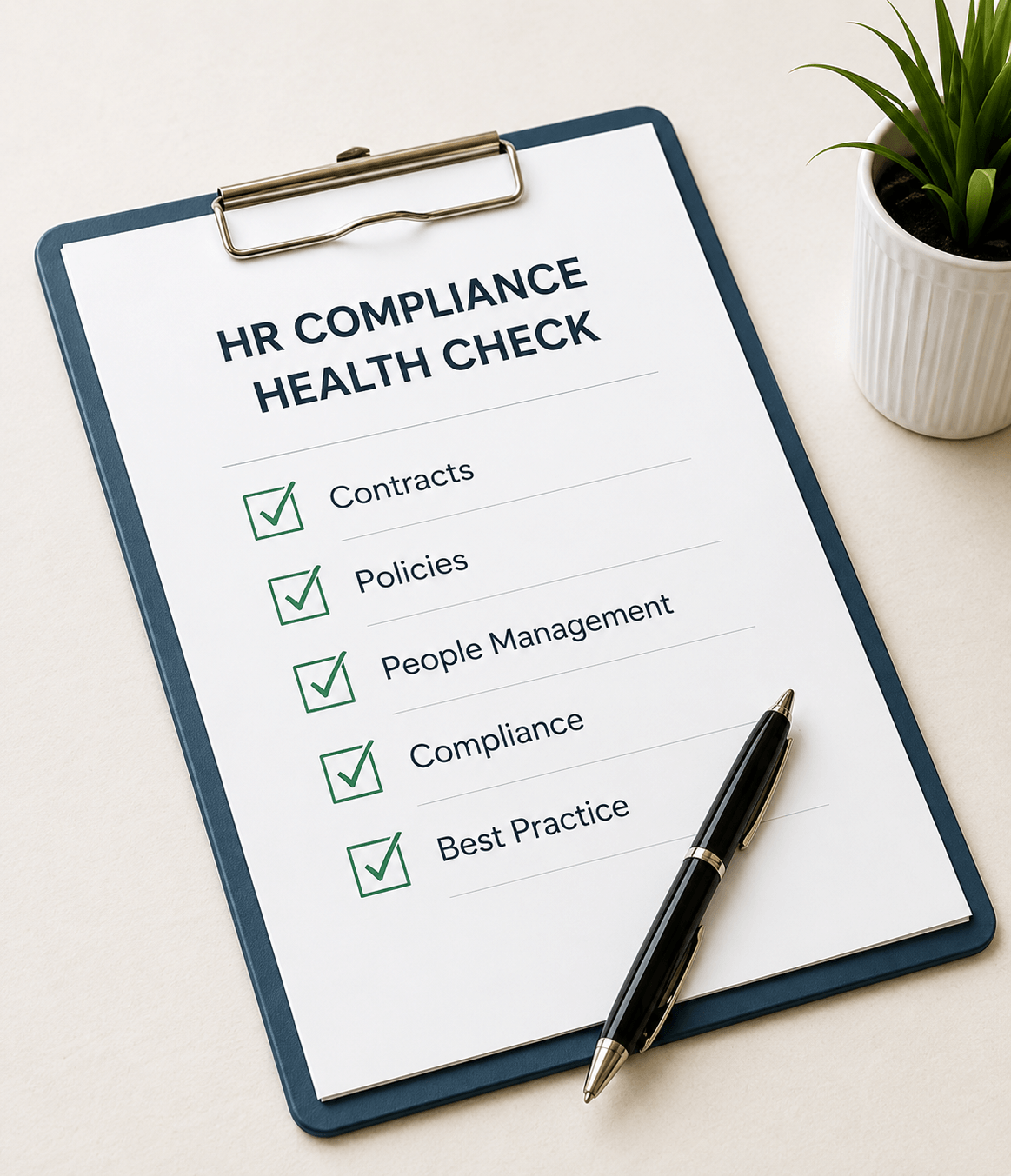
FREE HR COMPLIANCE HEALTHCHECK
How compliant is your business?
Take our free HR Compliance Healthcheck and get a personalised report in minutes.
Identify potential risks, strengthen your HR practices and gain peace of mind knowing you are on track.
Understand your HR strengths and blindspots
Spot gaps and reduce risk
Get clear, practical recommendations
Build a stronger, more compliant business.
Simple HR. Serious Protection.
Practical HR solutions for small and growing businesses.



QUICK LINKS
RESOURCES


People Policy Co. All rights reserved. © 2026