How SMEs Can Stay Compliant Without an In-House HR Team
Introduction
Many small and growing businesses reach a point where people management becomes increasingly complex, yet they are not in a position to hire an in-house HR professional.
This creates a common risk gap. Compliance obligations continue to increase, particularly with changes to employment law, but the internal capability to manage those obligations does not always develop at the same pace.
The result is often a reactive approach, where issues are dealt with only when they arise, rather than prevented through structure and consistency.
The key question is not whether SMEs can remain compliant without HR, but how they can do so effectively.
The Reality of Operating Without HR Support
In the absence of a dedicated HR function, responsibility for managing employees typically sits with business owners or line managers.
This can lead to:
Decisions being made based on instinct rather than process
Inconsistent handling of similar situations
Limited understanding of legal obligations
Lack of documentation to support decisions
Over time, this creates a level of risk that is often not visible until a dispute arises.
Where SMEs Are Most Exposed
From a practical perspective, the highest risk areas tend to be:
Employee Relations Issues
Disciplinary matters and grievances are often handled informally, without a clear process or documentation.
Absence and Health-Related Issues
A lack of understanding around the Equality Act can lead to inappropriate handling of disability-related absence.
Dismissals
Decisions may be made without a structured process, increasing exposure to claims.
Documentation Gaps
Contracts, policies, and records may be incomplete, outdated, or inconsistent.
A Practical Model for Staying Compliant
SMEs do not necessarily need an in-house HR function, but they do need a structured system. This should include:
1. Standardised Documentation
At a minimum:
Employment contracts
Core HR policies
Template letters and forms
These provide a consistent foundation for managing employees.
2. Defined Processes for Key Situations
Employers should have clear processes for:
Disciplinary action
Grievances
Absence management
Performance concerns
These processes should align with ACAS guidance and be applied consistently.
3. Manager Guidance and Training
Managers should not be expected to interpret employment law in real time.
Instead, they should be equipped with:
Clear guidance documents
Step-by-step processes
Templates to support decision making
This significantly reduces the risk of inconsistent or non-compliant actions.
4. Access to External Support When Required
Rather than ongoing retainers, many SMEs benefit from:
Ad hoc advice for complex issues
Implementation support when setting up documentation
Periodic reviews of HR practices
This provides flexibility while maintaining compliance.
The Role of Structure in Reducing Risk
The key differentiator between compliant and non-compliant SMEs is rarely knowledge. It is structure.
Where there is:
Clear documentation
Defined processes
Consistent application
The risk of disputes reduces significantly, even in the absence of a dedicated HR team.
Example Scenario
A business owner handles a disciplinary issue informally, based on previous experience, without following a defined process.
In a similar situation, a different manager takes a more formal approach, resulting in inconsistent outcomes.
An employee raises a complaint regarding unfair treatment.
Without a clear framework or documentation, the business struggles to demonstrate that decisions were fair and consistent.
Key Takeaway
SMEs do not need an in-house HR function to remain compliant, but they do need:
Structure
Consistency
Clear documentation
Defined processes
Without these elements, risk increases regardless of intent.
Other Related Articles
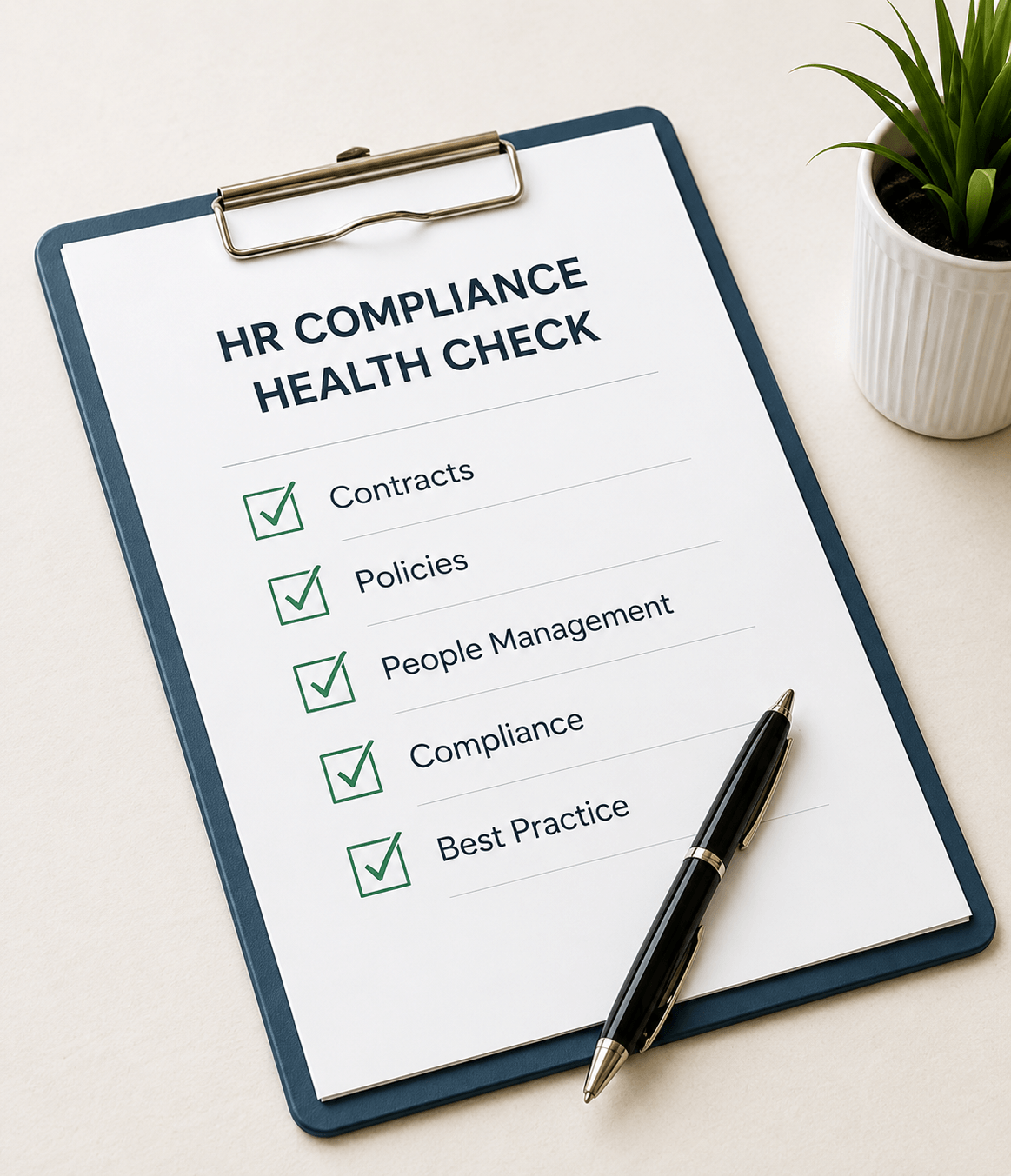
FREE HR COMPLIANCE HEALTHCHECK
How compliant is your business?
Take our free HR Compliance Healthcheck and get a personalised report in minutes.
Identify potential risks, strengthen your HR practices and gain peace of mind knowing you are on track.
Understand your HR strengths and blindspots
Spot gaps and reduce risk
Get clear, practical recommendations
Build a stronger, more compliant business.
Simple HR. Serious Protection.
Practical HR solutions for small and growing businesses.



QUICK LINKS
RESOURCES
People Policy Co. All rights reserved. © 2026